Kexin received the Dissertation Year Fellowship
Congratulations! Kexin received the UCLA Dissertation Year Fellowship.

Congratulations! Kexin received the UCLA Dissertation Year Fellowship.
Guan’ao received the award at the 2022 Department of Statistics Commencement. Congratulations Guan’ao!
The Harvard Radcliffe Institute Fellowship Program, now in its 22nd year, offers scholars and practitioners in the arts, humanities, journalism, sciences, and social sciences a chance to pursue their latest passions. This year, the program traditionally accepted only 50 fellows for the 2022-2023 class from across Harvard University and around the world. The historical acceptance […]
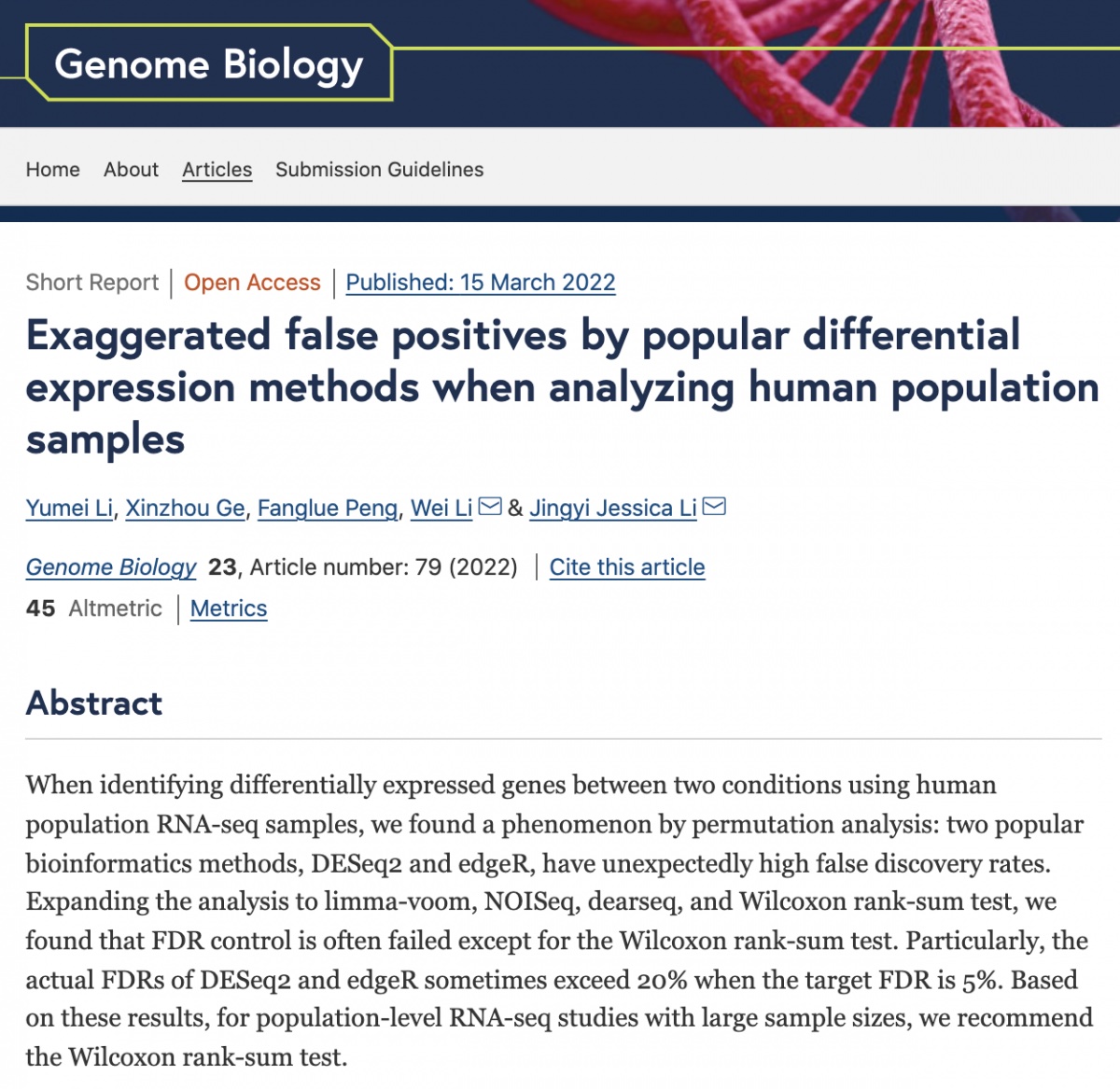
Thanks to the collaboration with Dr. Wei Li’s lab at UC Irvine, Yumei (UC Irvine) and Xinzhou co-wrote this article about inflated false discovery rates of popular differential expression methods on population RNA-seq samples. This phenomenon was discovered by permutation analysis. The work was published in Genome Biology. Here is the UCLA News. Congratulations!
Our undergraduate student Zhengtong Liu was selected into the UCLA Applied and Computational Mathematics REU Program Summer 2022. Congratulations Zhengtong!
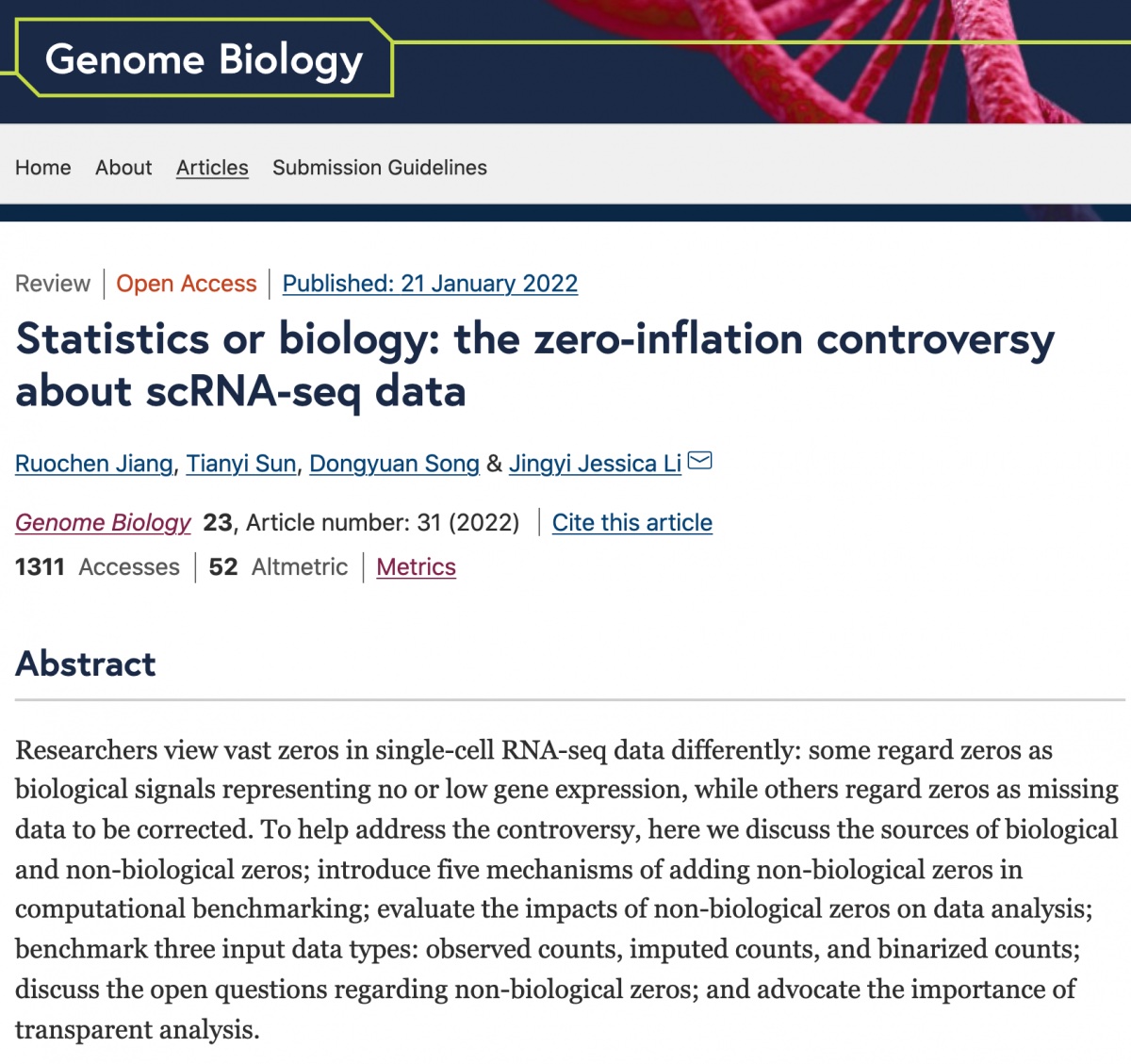
Ruochen, Tianyi, and Dongyuan co-wrote this review article about the zero-inflation controversy in the single-cell RNA-seq field. In particular, we clarify statistical and biological concepts; introduce 5 mechanisms of adding non-biological zeros for fair method benchmarking; and compare 3 input data types: observed, imputed, and binarized counts. The work was published in Genome Biology. Here is the UCLA News. Congratulations!
In the podcast, Jessica describes common statistical pitfalls in genomic data analysis & the statistical reasoning required to correct these mistakes. Common themes throughout include: hypothesis-driven science & critical scientific reasoning over data p-values and non-sensical null hypotheses/distributions the value of appearing statistically rigorous researchers cutting intellectual corners & digging themselves into local minima
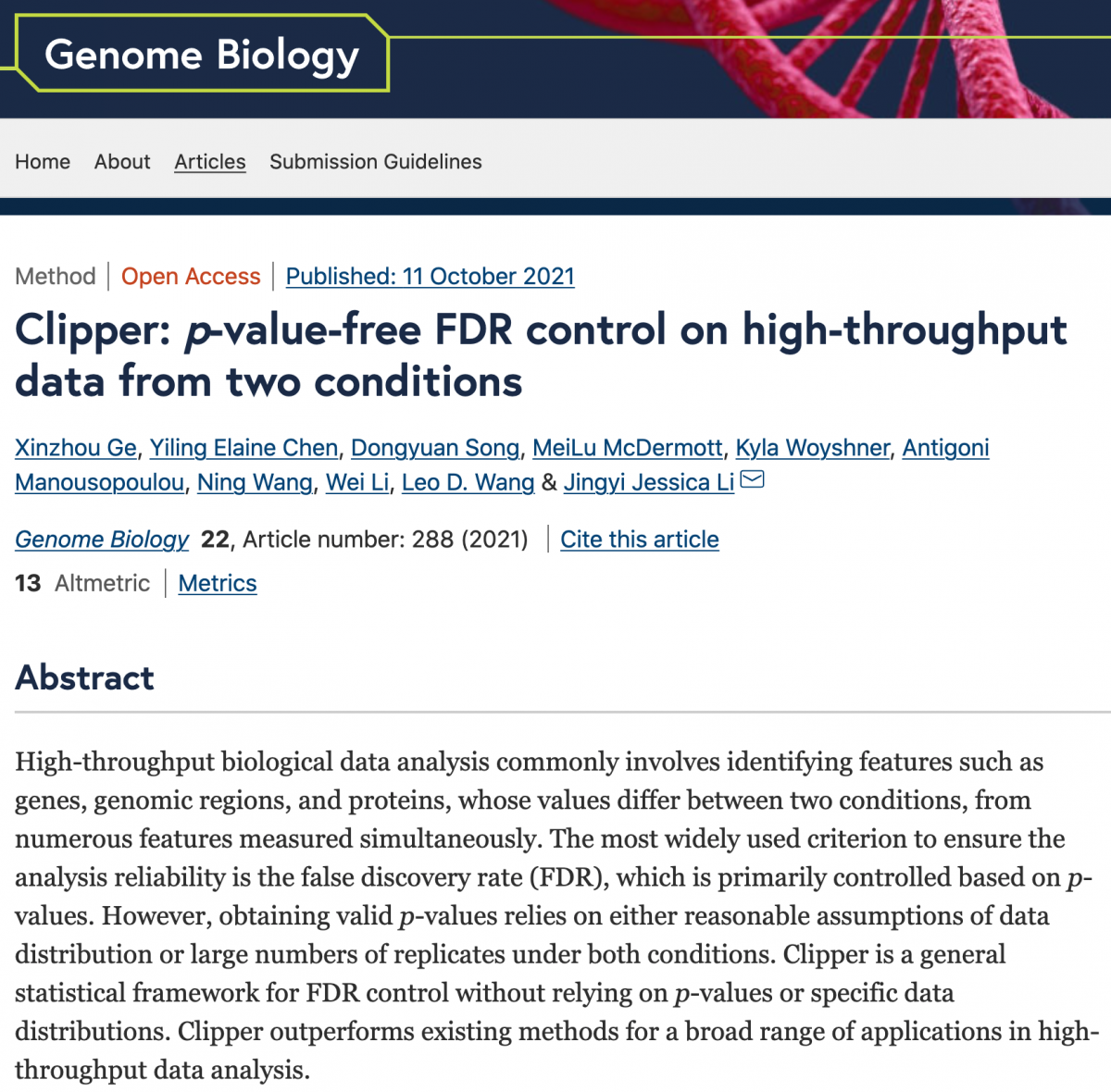
Xinzhou and Yiling developed Clipper, a general statistical framework for controlling FDR in high-throughout genomics data analysis. Clipper does not require high-resolution p-values, thus saving null distribution derivation and many rounds of permutations. The work was published in Genome Biology. Here is the UCLA news. Congratulations!
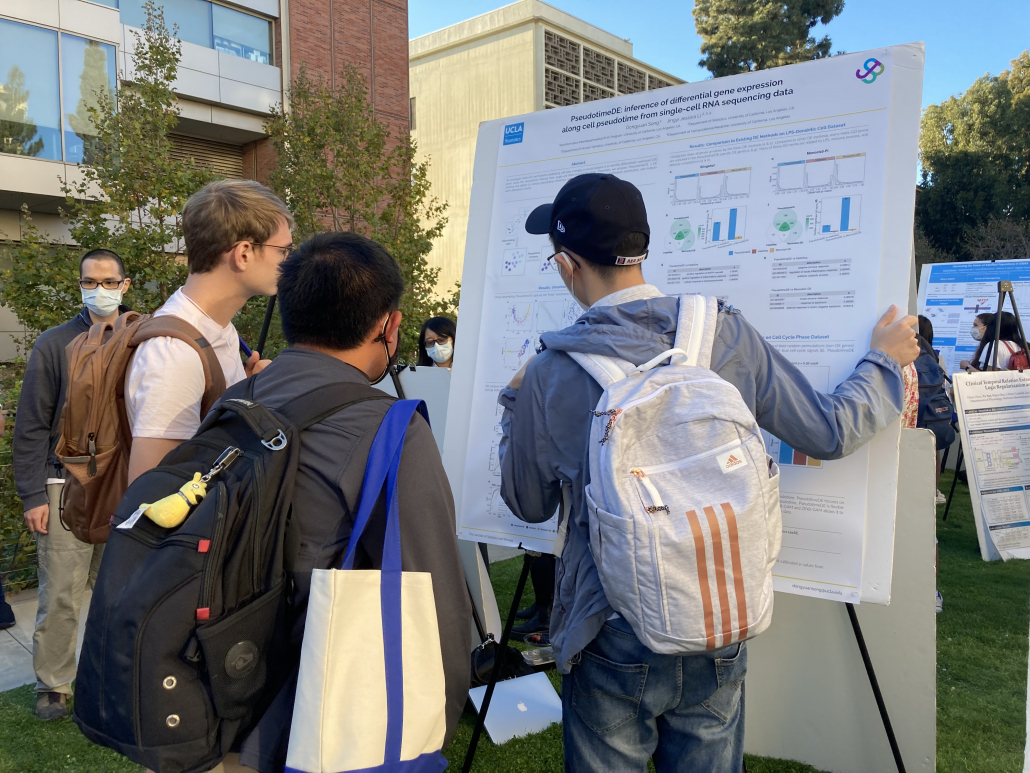
Dongyuan’s PseudotimeDE poster (attached) was selected among the top 5 posters at the QCBio 2021 Retreat. Congratulations to Dongyuan! PseudotimeDE_poster
In the podcast, Jessica discusses her paper “Statistical Hypothesis Testing versus Machine Learning Binary Classification”. She noticed several high-impact cancer research papers using multiple hypothesis testing for binary classification problems. Concerned that these papers had no guarantee on their claimed false discovery rates, she and co-author Xin Tong wrote a perspective article about clarifying hypothesis testing and binary […]